The credits-index layout: Mattia Saggiomo lists his reel like film end-credits
A colorist's portfolio that reads like a call sheet. One monospace face, a client-project-role-year ledger, and all the color left inside the work.
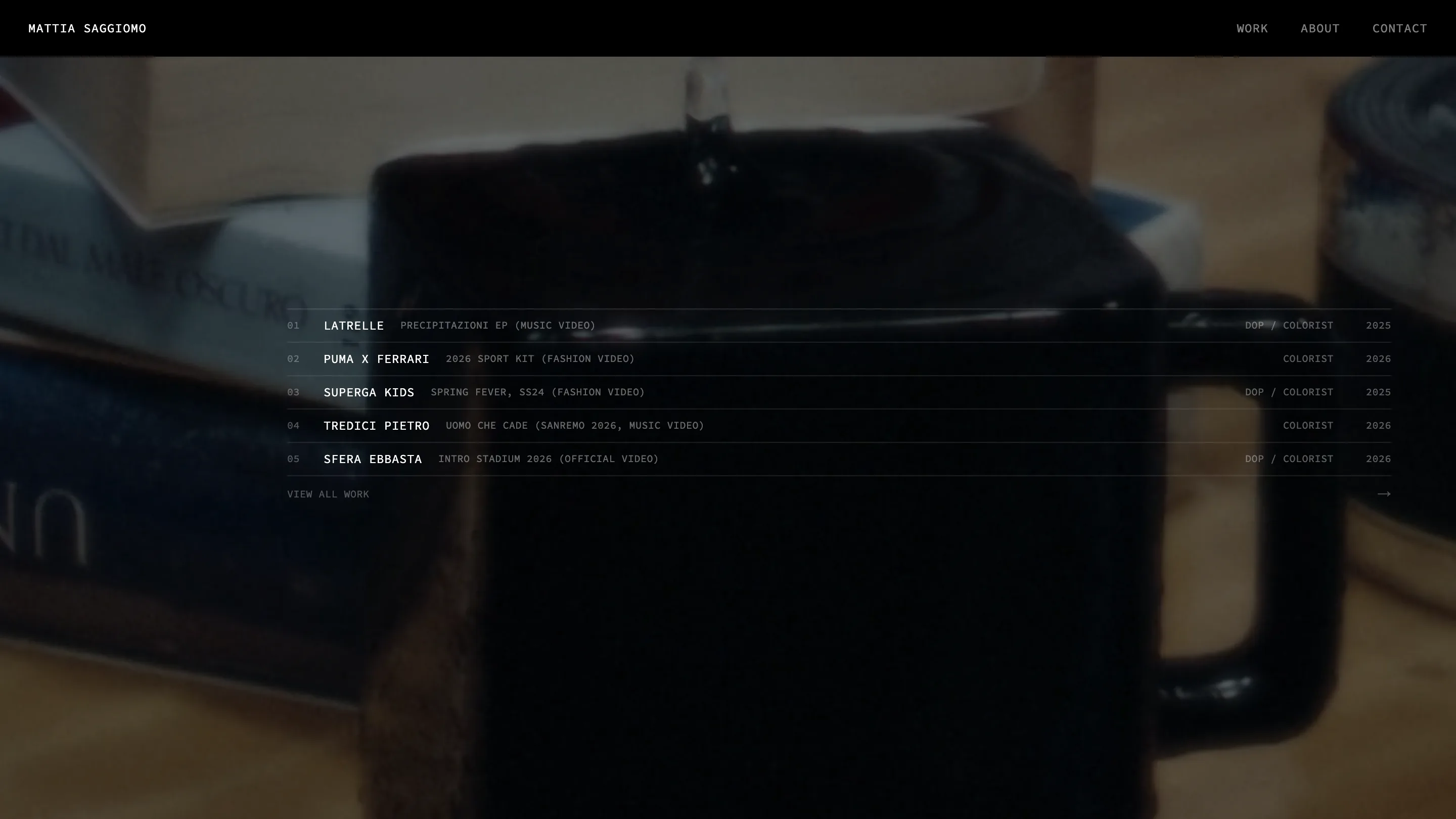
I keep coming back to portfolios that trust a list. Mattia Saggiomo is a Milan colorist and DOP, and Giuseppe De Stefano built him a site that runs on one idea: the whole interface is a credits index. Client, project, role, year, set in a single monospace face, right-aligned like the end-credits of the films he grades. I found it on Minimal Gallery and it stuck.
The design idea worth stealing here is the ledger. Not a hero, not a headline. A ranked list that carries the whole homepage.
The homepage is a ledger over a moving reel
The landing screen plays a slow, warm shot behind everything: a candle, a record player, amber light. On top of it sits a five-row index. 01 LATRELLE, 02 PUMA X FERRARI, 03 SUPERGA KIDS, each with the project title dimmed next to the client, then the role and year pushed to the far right edge. DOP / COLORIST. 2026. Thin hairlines between the rows.
What I like is how much the row does with so little. The two-digit number gives it rank. The role tag tells you exactly what he touched, because on some jobs he shot and graded, on others he only graded. The year sits where a ledger would put it. You read one line and you know the job. No card, no thumbnail, no hover trick needed on the home screen.
The grid drops the gutters
Click through to the work and the list becomes a wall. Forty-two frames in a three-column grid with almost no gutter, so the stills touch and the page reads like a contact sheet.

The filter row keeps the ledger habit going: ALL [42], VIDEOCLIP [29], FASHION [10], COMMERCIAL [03]. The counts live in brackets, so you know the shape of the archive before you click. A GRID / LIST toggle sits top right for people who'd rather read the same forty-two as text. Every cell keeps its number and its role tag in the corner. It's the home index again, this time with pictures.
Grayscale chrome, color only in the work
This is the move I'd keep. The interface is black, white, and gray monospace, top to bottom. So the only color on the whole site comes from the footage itself: the red PUMA Ferrari helmet, the orange oversized glasses on the Superga kids, a stark black-and-white close-up of Sfera Ebbasta, a navy suit against a stone manor. For a colorist that's the right call. His job is the color grade, so the chrome steps back to zero and lets the grade be the loudest thing on screen.
It's a discipline more portfolios could use. When the work is visual, a colored button or a gradient header just competes with it. Here nothing competes.
The about page proves the system
The about page is pure black with three monospace columns: SERVICES, SELECTED CLIENTS, SELECTED ARTISTS. Adidas, Giorgio Armani, Nike, Universal Music down one side. Central Cee, Lazza, Geolier, Sfera Ebbasta down the other.
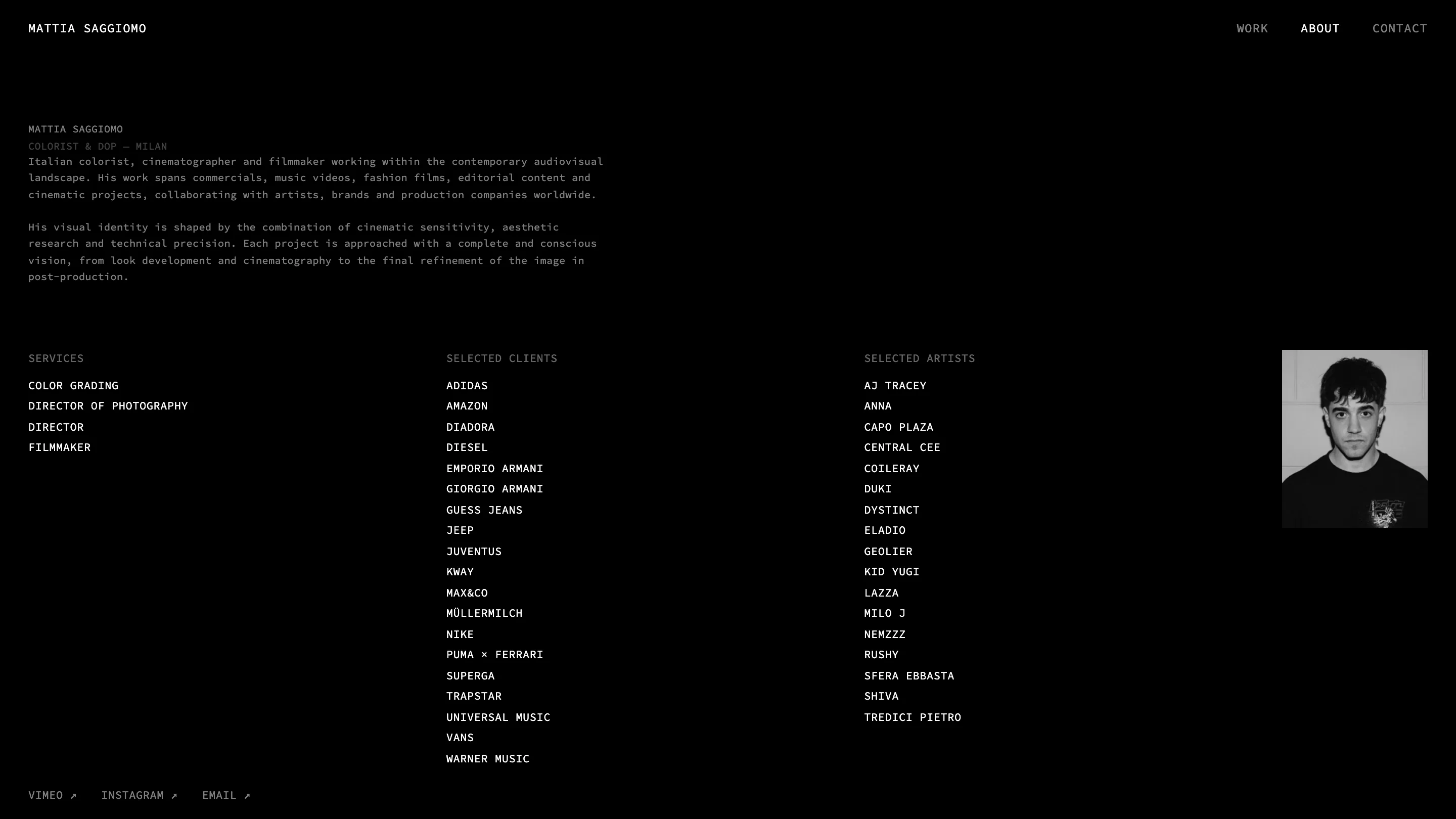
Again it's a list doing the persuading. No paragraph telling me he's worked with big names. Just the names, aligned, in the same face as everything else. A small black-and-white portrait in the corner is the one soft touch.
What I'd keep
Three things. The credits-row as a unit: client, project, role, year, so one line answers every question a viewer has. The bracketed counts, which turn a filter bar into a map of the archive. And the grayscale rule that hands all the color to the work. It's a plain system, and plain is why it holds. Credit to Mattia Saggiomo and Giuseppe De Stefano, found on Minimal Gallery.